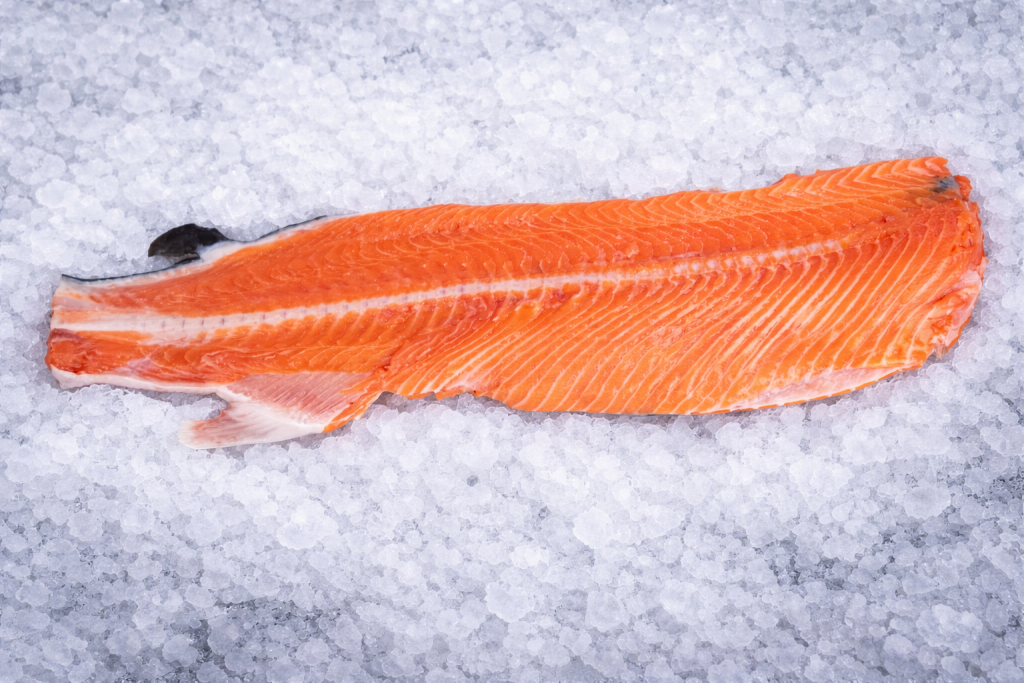
Salmon backbones are a fish raw material intended for further processing. The product is made from farmed Atlantic salmon Salmo salar and is offered in frozen form. This format facilitates transport, storage, and use in plants working with larger volumes. It is chosen by companies that need a raw material for meat recovery, preparation of fish components, or production of scraped meat blocks. For B2B customers, the key factors are a consistent delivery format, absence of additives, and parameters tailored to industrial production regimes. The product requires heat treatment before consumption.
Why choose this product from Master Meat?
When working with fish raw materials, not only the product parameters matter, but also how well the product fits into day-to-day production management. Frozen salmon backbones meet the needs of businesses that want to maintain process continuity and reduce the risk of raw material losses.
- Format for further processing – suitable for plants that recover meat or prepare fish-based components.
- Practical packaging – two 10 kg bags in a master carton make logistics and raw material dosing easier.
- Long shelf life – 18 months at a temperature not higher than -18°C supports purchasing and production planning.
- No additives, injection, or glaze – the customer receives a simple raw material for further processing.
- Clearly defined quality requirements – the product has specified microbiological and chemical criteria.
For industry customers this means greater process predictability, easier stock management, and better alignment of the raw material with their own technology.
Applications in industry and foodservice
Salmon backbones are intended primarily for food processing. They can be used as a raw material for meat recovery and for preparing fish semi-finished products for further processing. They are a practical choice for companies producing scraped meat blocks, fish fillings, and other components that require a standardised input material. The product is suitable wherever the ability to work with frozen batches, maintain consistency, and store safely in cold storage is critical. Due to its nature and intended use, this is a typical industrial raw material, used after technological and thermal processing.
Key properties and technical data
The most important characteristics of this raw material have a direct impact on production and logistics. The product comes from farmed salmon and is supplied frozen, which supports supply stability and longer storage.
- Species: salmon, Salmo salar.
- Product form: salmon backbones.
- Production method: farmed.
- Processing method: deep-frozen product.
- Ingredients: salmon backbones, no additives.
- Injection: none.
- Glaze: none.
- Packaging: 2 blue plastic bags of 10 kg each in a 20 kg master carton.
- Shelf life: 18 months from freezing date at a temperature not higher than -18°C.
From a B2B perspective these parameters are crucial for production planning, storage, and batch accounting.
Quality and hygiene standards
The product is subject to microbiological and chemical requirements relevant to the safe handling of fish raw materials. The specification defines limits for total bacterial count and the presence of Salmonella, Listeria monocytogenes, Escherichia coli, and coagulase-positive staphylococci. Limits for heavy metals and the maximum TVB-N level are also specified. The raw material contains the allergen fish and is declared as GMO-free. Each batch is labelled, and the markings include, among others, the product name, Latin name of the raw material, origin, net weight, LOT number, freezing date, use-by date, and storage conditions. The product must be stored and transported at a temperature not higher than -18°C and used only after heat treatment.
Who is this product intended for?
This solution is designed for companies looking for salmon raw material for further processing. It is best suited to processing plants that recover meat from fish parts and prepare semi-finished products for subsequent production stages. It is also a good choice for customers who need a frozen raw material that is easy to store and delivered in functional bulk packaging. Where priorities include batch predictability, clear storage conditions, and a format suitable for industrial use, frozen salmon backbones are a practical choice for production applications.
Technical specification
| Parameter | Value |
|---|---|
| Product name | Salmon backbones |
| Species | Salmon |
| Latin name | Salmo salar |
| Product form | Backbones |
| Processing method | Frozen, deep-frozen product |
| Production method | Farmed |
| Country of origin | Norway / Iceland / Scotland / Chile |
| Ingredients | Salmon backbones |
| Size / grade | Mix |
| Injection | None |
| Glaze | None |
| Allergens | Fish |
| GMO | GMO-free product |
| Net weight | 20 kg |
| Unit packaging | 2 blue plastic bags of 10 kg |
| Outer packaging | Labelled, banded 20 kg master carton |
| Transport protection | Stretch film |
| Carton | White top 589x379x113 / grey bottom 589x389x113 |
| Pallet | EURO or one-way wooden 1200 x 800 x 140 mm |
| Cartons per layer | 11 |
| Number of layers | 4 |
| Cartons per pallet | 44 |
| Shelf life | 18 months from freezing date |
| Storage conditions | Not higher than -18°C |
| Transport conditions | Not higher than -18°C |
| Intended use | Further food processing, use after heat treatment |
| Total bacterial count | Target: < 500,000 cfu/g, max.: < 1,000,000 cfu/g |
| Salmonella | Absent in 25 g |
| Listeria monocytogenes | Absent in 25 g |
| Listeria monocytogenes – count | Target: < 10 cfu/g, max.: < 100 cfu/g |
| Escherichia coli | Target: < 10 cfu/g, max.: < 100 cfu/g |
| Coagulase-positive staphylococci | Target: < 10 cfu/g, max.: < 100 cfu/g |
| Cadmium (Cd) | 0.05 mg/kg |
| Lead (Pb) | 0.30 mg/kg |
| Mercury (Hg) | 0.30 mg/kg |
| Maximum TVB-N level | 35 mg/100 g |
B2B Wholesale Inquiry – Master Meat
Thank you for your interest in Master Meat’s offer. This form is intended for companies, wholesalers, processing plants and export customers. Based on the information provided, we prepare individual commercial offers.
We serve:
- meat processing plants,
- distributors and wholesalers,
- retail chains,
- individual and B2B export.
After submitting the form, you will receive an automatic confirmation. Our sales department will contact you as soon as possible.
Wholesale inquiry: Frozen Salmon Backbones
Contact details
Inquiry information
Logistics and delivery
Additional information
FAQ – Frequently Asked Questions
What are frozen salmon backbones suitable for?
Are salmon backbones suitable for food processing?
How are salmon backbones packed?
How should salmon backbones be stored after delivery?
What is the shelf life of frozen salmon backbones?
Do salmon backbones contain glaze or injection?
Which species are the salmon backbones from?
Are salmon backbones ready to eat?
Do salmon backbones have defined microbiological requirements?
Who are frozen salmon backbones best suited for?